


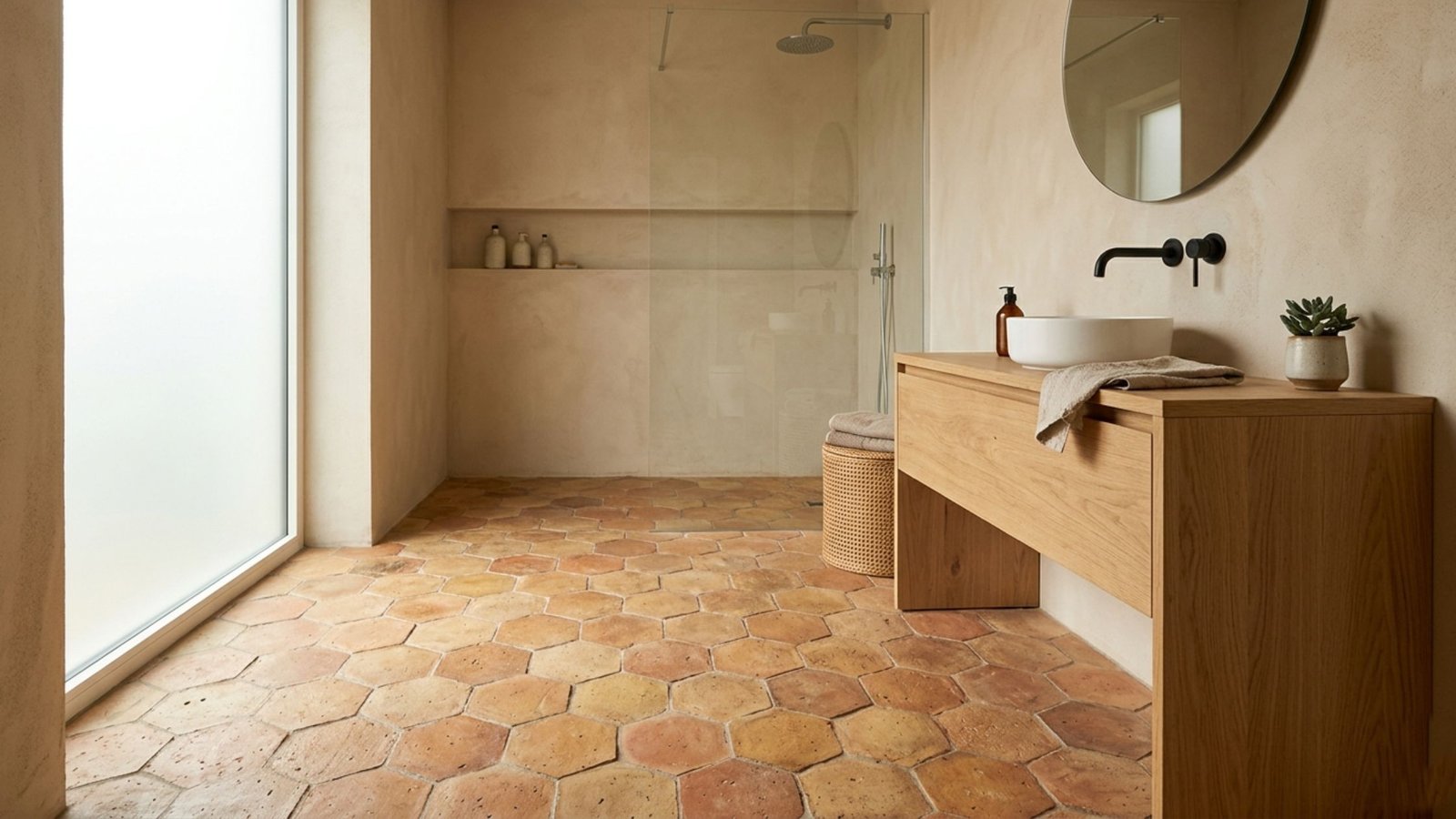
The bathroom is the only room where the question of material is asked most honestly. No piece of furniture to compensate. No layer of textile to soften the impression. What is here – is here. Floor, wall, water, light and time. In this reduced environment, a material holds up or it doesn’t. There is no middle ground.
Which is precisely why many who are drawn to handcrafted terracotta tiles hesitate here of all places. They have seen the material in kitchens, on terraces, in living rooms – and like what it does to a space. But the bathroom feels different. More water. More steam. Less room for error. And somewhere in the background, a quiet concern: Can a porous, ancient material really belong in the wettest room in the house?
This text does not attempt to convince anyone of anything. It attempts to give an honest answer – because the answer is far more nuanced than a simple “yes, without reservation” or “no, too great a risk.” The right answer depends on understanding what terracotta is, how it behaves and what the bathroom actually demands of it.
Terracotta Tiles in the Bathroom – and Why Water Is No Argument Against It
The assumption that terracotta and water are incompatible is widespread – and wrong, though not without reason. Untreated terracotta is porous. It absorbs liquids. Place an unsealed tile in a damp environment and leave it unprotected, and problems will follow: staining, moisture absorption and, over time, potential structural deterioration.
But that is not a description of terracotta in a well-planned bathroom. That is a description of a material used without understanding its system.
Every material in the bathroom needs protection. Marble stains without sealing. Wood swells without treatment. Even industrial porcelain stoneware, marketed as a maintenance-free material, develops grout lines over time that absorb moisture and change colour. The question is never whether a material needs care – but what kind of care, and whether the system around it has been correctly planned.
For handcrafted terracotta, the answer is: sealing. Not as a workaround, not as a compromise – but as a fundamental part of the way this material should be used. A correctly sealed terracotta tile does not absorb water. Drops roll across the surface and can be wiped away without any trace. The material beneath remains dry, stable and undamaged.
This is not new technology. This is how terracotta has been used in Mediterranean baths, Turkish hammams and European thermal spas for centuries – in environments far more demanding than any private bathroom.
What Sealing Actually Does
There is a persistent confusion between impregnation and surface sealing – and in the context of the bathroom, this distinction matters greatly.
A surface sealant – lacquer, epoxy or similar coatings – sits on top of the tile and creates a physical barrier. This can be effective, but it completely alters the character of the material. The tile loses its vapour permeability, its tactile depth, its natural matte quality. What remains looks like terracotta but no longer behaves like it. Practically speaking: sealed surfaces in wet rooms eventually peel, crack or detach, particularly under the influence of steam and temperature fluctuations. When that begins, the situation is worse than if nothing had been applied at all.
Impregnation works differently. It penetrates the pores of the tile and coats them from within, without closing the surface. The tile remains vapour-permeable. It can still breathe – releasing moisture rather than trapping it. The surface retains its texture, its softness underfoot and its natural response to light. What changes: liquids can no longer penetrate. They remain on the surface, waiting to be removed.
This distinction – vapour-permeable versus hermetically sealed – is not academic. In the bathroom, where steam and temperature cycles are constant, a material that can release vapour is more stable in the long term than one that is hermetically closed. Terracotta, correctly impregnated, functions in the bathroom not despite its porosity – but in part precisely because of it.
Practical note: Impregnation should be applied before grouting, not after. The order matters: lay the tiles, impregnate, then grout. This prevents the grout from staining the tile surface and ensures that the protection reaches all the way to the edges. Impregnation should be renewed every few years – a simple water drop test on the surface shows whether it is time for renewal.
Further reading: Protection for Generations – How to Properly Impregnate Terracotta Tiles
Steam, Moisture and Ventilation – the Decisive Variables
Water on the tile is solvable. Steam is the variable that actually determines whether a bathroom is suitable for terracotta – and the answer depends almost entirely on ventilation.
In a well-ventilated bathroom, steam disperses. The tile surface may become damp during a long shower, but dries within minutes afterwards. In this scenario, terracotta functions without issue. The surface remains intact, the impregnation holds, and the material ages with dignity.
In a poorly ventilated bathroom, the situation is different. Persistent moisture – not acute wetness, but chronic dampness – is a condition that puts every natural material under strain. Terracotta can withstand wetness; what becomes more difficult is the constant alternation between wet and dry without adequate drying time. In such spaces, the long-term performance of every material is compromised – terracotta is no exception.
An honest recommendation: If you are renovating a bathroom and considering terracotta, assess the ventilation before you assess the tile. If the room has a functioning ventilation opening and at least one window that can be opened, you are in a range where terracotta functions without restriction. If the room is small, windowless and frequently used by multiple people, improve the ventilation first – and then choose the material.
This is not a weakness of terracotta. It is a fundamental principle of building physics that applies to every organic, mineral or porous material in high-humidity environments.
The Shower Zone: Where Precision Matters Most
The general floor and walls of the bathroom present no particular challenge for a correctly treated terracotta installation. The shower zone is the area where planning must be more precise – and where the difference between handcrafted and industrial materials becomes most apparent.
In a shower enclosure with direct spray, the water load is concentrated and constant. Here, the installation details are just as important as the tile itself:
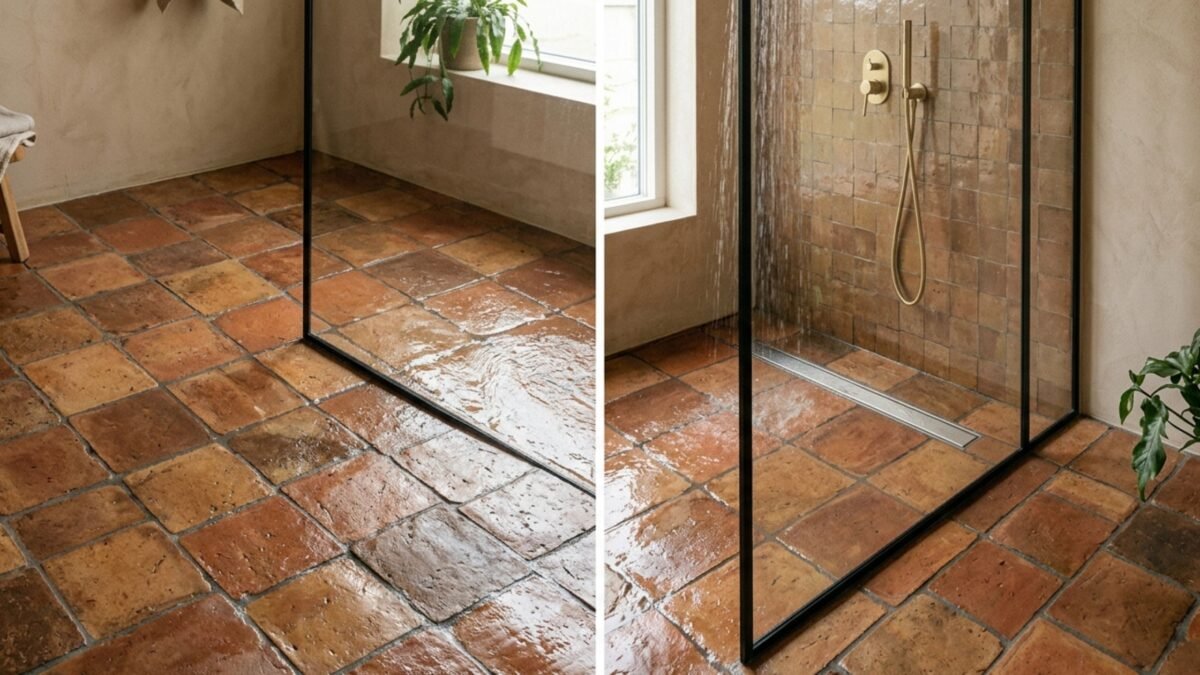
Subfloor preparation is crucial. The screed beneath the tiles must be fully waterproofed, with a correctly applied waterproofing membrane extended up the walls to an appropriate height. The membrane carries out the actual waterproofing – the tile is not a waterproofing layer, regardless of the material.
The gradient must be precise. In every shower installation, tiles must be laid with a constant gradient of at least 1–2% towards the drain. With handcrafted terracotta, where surface variations are part of the material, achieving a consistent gradient requires skilled installation. A poorly sloped shower accumulates standing water; with a porous material, this becomes a greater problem than with glazed ceramic.
Grout sealing in the wet zone requires a flexible, waterproof grout compound – not standard cement mortar, which can crack under thermal movement. The transition between tiles and any fixed surface (wall-to-floor, door frame, drain edge) must be executed with a flexible sealant, not a rigid grout joint.
Practical note: In the shower zone, impregnation alone is not sufficient protection at joints and transitions. The tile body may be protected – but a cracked or inadequately sealed grout joint becomes a pathway for moisture to reach the subfloor. Tile and grout are a system. Both must be correctly planned and installed.
Further reading: Joints and Transitions in Handcrafted Terracotta Tiles – When Details Decide Architecture
For clients who like terracotta but have reservations about its use in the shower, a practical solution is to use terracotta for the general bathroom floor and transition to a different material inside the shower enclosure – natural stone or small-format unglazed ceramic. This allows the character of terracotta to define the space without placing it in the most demanding position.
Underfloor Heating in the Bathroom: a Natural Combination
One aspect of terracotta in the bathroom that is consistently underestimated is its relationship with underfloor heating – particularly in a room where barefoot contact with the floor is the norm.
Terracotta has excellent thermal mass. It absorbs heat slowly and releases it slowly. With a heated bathroom floor, this means the surface warms evenly and retains that warmth longer after the heating cycle has ended. The difference between stepping onto a cold porcelain stoneware floor and a warm terracotta floor in January is not subtle.
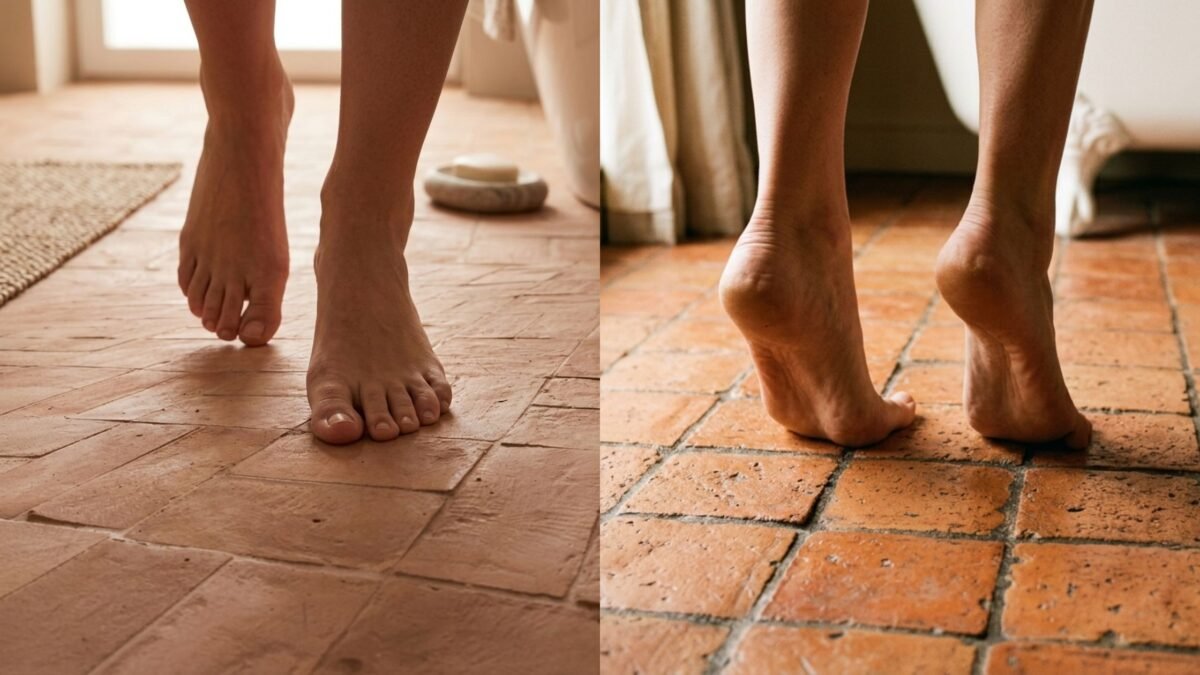
Technically, handcrafted terracotta is compatible with both hydronic and electric underfloor heating systems when correctly installed. The screed must be fully cured and the heating system tested before laying the tiles. Adhesive and grout must be certified for heated substrates. Thermal expansion must be accounted for in the grout layout – wider joints and expansion joints at the perimeter prevent the buckling that can occur when rigid materials are alternately heated and cooled.
The only terracotta-specific note in this context: the heating cycle should not be extreme. Gradual temperature changes – no abrupt switching on and off – are better for every natural material. This is standard practice for any high-quality underfloor heating installation and does not represent a particular limitation for terracotta.
Further reading: Natural Warmth Underfoot – Terracotta Tiles and Underfloor Heating
Ageing in the Bathroom: What Changes and What Does Not
In the bathroom, the ageing of a material is visible in a particular way. The space is intimate and visited daily. Every change to the floor or wall surface is registered immediately – in a way that might not be as noticeable in a larger, more varied room.
With handcrafted terracotta in the bathroom, ageing is almost exclusively positive – provided the material has been correctly installed and maintained.
The surface develops a subtle patina. High-traffic areas – the path from the shower to the door, the zone in front of the washbasin – darken slightly over the years. The tile absorbs traces of use the way worn stone steps do: not as damage, but as evidence of time. The colour deepens; the texture becomes slightly softer. The room feels more alive – not in the sense of neglect, but in the sense of continuity.
What does not change: the structural integrity of the tile, the dimensional stability of the installation, the fundamental behaviour of the material. Terracotta fired at high temperatures is dense, hard and dimensionally stable. It does not bend, swell or delaminate. The surface that is installed is the surface that remains – changed in character, not in function.
This deserves to be stated clearly, because it contrasts with the ageing behaviour of many commonly used bathroom materials. Vinyl and laminate surfaces degrade over time – edges lift, patterns fade, water ingress ultimately destroys them. Grout joints in standard ceramic installations discolour and require periodic re-grouting. Even high-quality natural stone requires regular maintenance to prevent etching and staining. Terracotta, with periodic re-impregnation, demands comparatively little and in return gives back a floor that becomes more distinctive over time – not more tired.
The Aesthetic Argument: Why the Bathroom Benefits from Terracotta
Alongside the technical dimension, there is a spatial argument for terracotta in the bathroom that deserves to be articulated separately – because it operates on a different level.
The modern bathroom has in many cases become a highly controlled environment. White, grey, glossy, precise. Materials are chosen for a hygienic aesthetic – a visual language that equates cleanliness with the absence of variation. The result is often correct, but cold. A space that functions well, but offers the senses nothing beyond the temperature of the water.
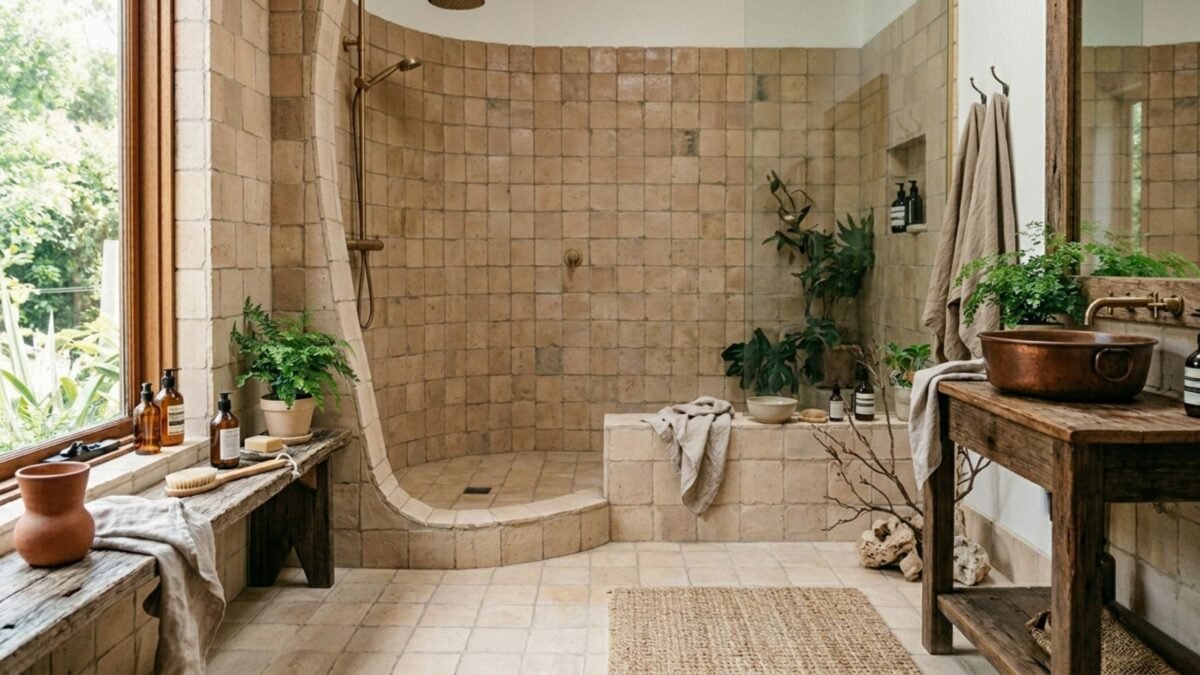
Terracotta brings something different: warmth – not in the marketing sense, but as a physical and perceptible reality. The warm earth tones – ochre, sienna, terra rossa – are not decorative colours applied to a neutral surface. This is the colour of the material itself, coming from within. Light moves across a terracotta floor differently than across white porcelain stoneware. Variations on the tile surface create micro-shadows that shift throughout the day. In a bathroom with good natural light, this effect is significant. The room feels present in a way that a uniform surface cannot achieve.
In spaces where the design intention is calm – where the bathroom is understood not as a functional room but as a place of restoration – terracotta works with the architecture, not against it. It demands no attention. It creates an atmosphere in which the material is simply there: honest, warm and lasting.
That is precisely what a spa bathroom, a wellness space or a carefully conceived private bathroom needs. Not spectacle – but a material that allows the room to be itself.
When Terracotta Is Not the Right Choice for the Bathroom
An honest assessment must also include the cases where terracotta is not the appropriate material.
Rental properties and environments with high tenant turnover: Terracotta requires an awareness of maintenance that cannot be guaranteed with multiple tenants. A single application of an unsuitable cleaning product – bleach, acidic descaler, abrasive cleaner – can damage the impregnation and require a complete reapplication. In environments where the owner cannot control daily maintenance practices, a lower-maintenance material is the more pragmatic choice.
Bathrooms without adequate subfloor waterproofing: Membrane and screed beneath the tile must be correctly executed. If the existing subfloor is questionable or the renovation budget does not allow for proper subfloor preparation, this is not the moment for a material that depends on good installation in order to function well.
Clients who expect zero maintenance: Terracotta is not a demanding material – but it is not a maintenance-free one either. The expectation of complete indifference towards the floor is incompatible with any natural material, and this should be established clearly during the planning phase. Those who value the material and are willing to engage minimally – periodic re-impregnation, appropriate cleaning products, awareness of what comes into contact with the floor – will find terracotta an exceptionally rewarding material. Those seeking absolute passivity will be happier with fully glazed porcelain stoneware.
Summary: the Conditions Under Which Terracotta Functions in the Bathroom
The question is not whether terracotta can function in the bathroom. It can. The question is whether the conditions for it to do so have been established.
These conditions are: correctly prepared and waterproofed subfloor; professional installation with appropriate adhesive and grout; impregnation as a standard part of the process, not an afterthought; adequate ventilation in the room; and a maintenance approach that treats the floor as a natural material – not an inert surface.
When these conditions are met, handcrafted terracotta in the bathroom is not a compromise and not a calculated risk. It is a considered architectural decision – one that brings warmth, material depth and a quality of ageing that modern bathrooms rarely achieve with any other material.
The concern with which people ask this question is understandable. The answer, when the conditions are clear, is simpler than it looks.
Further reading: