

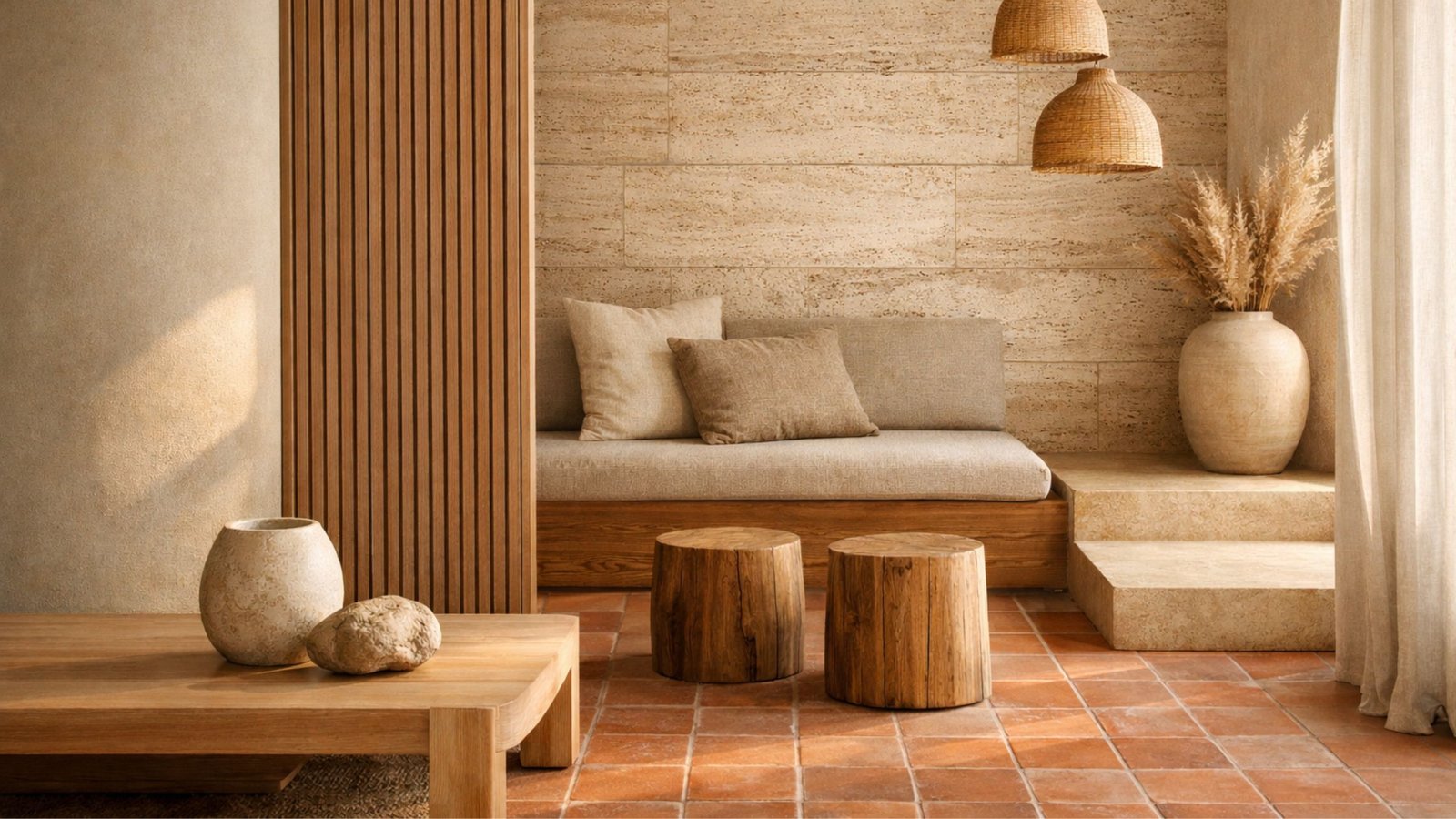

The term Warm Minimalism is often understood, in the context of 2026, as an aesthetic correction—a response to the visual coldness of a minimalism that for too long was reduced to form, color, and image. This reading, however, falls short. In architectural practice, Warm Minimalism does not emerge as a consciously chosen style, but as the result of a deeper shift in how materials are approached and understood.
What is perceived as “warm” today is not primarily created through nuance or texture, but through mass, depth, and physical presence. Spaces do not feel calmer because they are designed to be softer, but because materials once again behave like materials—with weight, resistance, and time acting as active components of the space.
Warm Minimalism as a Result, Not a Design Intention
In contemporary architecture, a clear shift in focus can be observed. The discussion is increasingly moving away from the logic of renderings and toward the question of how spaces behave in real use. In this context, Warm Minimalism does not arise as an aesthetic decision, but as a byproduct of a more conscious and deliberate engagement with materiality.
When surfaces are required to do more than merely look good—to engage acoustically, thermally, and through touch—the character of a space evolves naturally, without artificial enhancement. Warmth is no longer a design goal, but the outcome of a return to materials that possess depth, authenticity, and physical presence. In this sense, Warm Minimalism is not a spatial style, but the consequence of material choice.
The Limits of Lightweight Imitations in Real Space
Lightweight, industrially manufactured materials were long considered a rational solution. They promise speed, predictability, and visual neutrality. Within space, however, they remain materially passive. They do not respond to use, nor do they change over time.
In contemporary open-plan dwellings, where the number of elements is deliberately reduced, each material assumes a disproportionate role. When a lightweight imitation is introduced into such a space, the floor or wall loses its structural and spatial function and becomes a neutral backdrop. The result is not calm, but emptiness—a space that does not withstand use, but withdraws from it.
In this case, visual warmth remains a short-lived illusion. A lightweight imitation may appear warm, but it cannot carry a space.
The Return of Mass as a Spatial Argument
As expectations for lasting spatial quality increase, materials with substantial physical presence are regaining importance. Dense, mineral materials respond uniquely to light, store thermal energy, and contribute to the acoustic performance of a space. A material without mass cannot generate atmosphere, because without physical resistance there can be no spatial dialogue.
The choice of lightweight materials is often justified by flexibility. In practice, however, this flexibility means that a space becomes dependent on furniture, lighting, and decoration to develop character. When these elements are reduced or altered, what remains is a construction without conviction. Heavy materials, by contrast, sustain a space even when it is reduced to its essentials.
Handcrafted Traditional Terracotta Tiles as a Material Case Study
In this context, handcrafted traditional terracotta tiles appear not as a stylistic device, but as a material response. Their value lies not in appearance, but in behavior.
The thickness and physical mass of terracotta lend floors a distinct sense of stability and inertia. This material presence affects both the acoustics and thermal performance of a room. Its surface interacts with light without glare, revealing different nuances as the day progresses. Variations that might be regarded as defects in industrial manufacturing are, in this context, valued as functional characteristics. Sie brechen Monotonie und verhindern visuelle Trägheit. In spaces with few elements, a material has nowhere to hide.
It is important to note that, in contemporary architecture, terracotta is not used as a historical reference. It represents neither rusticity nor nostalgia, but rather serves as a material counterpoint to precise, contemporary lines. Materials that attempt to adapt to everything quickly lose their identity; terracotta endures because it possesses conviction from the outset.
Patina and Time as Part of the Architectural Language
A central question in today’s approach to materials is how they age. Authentic materials change over time. They absorb the traces of use and develop a patina that lends a space a sense of continuity. Patina is a sign that a space is alive; uniformity is a sign that it was finished before it was ever used.
Handcrafted traditional terracotta tiles integrate time into their material logic. The surface gains depth and character without losing its function. This makes them suitable for spaces conceived not as scenography, but as long-term environments.
From Aesthetics to Specification: A Question of Professional Discipline
At this point, Warm Minimalism finally separates itself from style. When material is reduced to a mere surface, architecture relinquishes part of its responsibility. Material selection in the early phases of a project is not an aesthetic decision, but a spatial one. It determines how a space sounds, how it behaves throughout the seasons, and how it ages.
Ignoring this responsibility means leaving the atmosphere of a space to chance. When materials are specified early and consistently, atmosphere is no longer the result of decoration, but the structural expression of the design. Architecture does not become calmer by becoming softer, but by becoming more truthful.
Conclusion: Criteria Instead of Styles
If Warm Minimalism in 2026 is understood solely as an aesthetic movement, it loses its relevance. In that case, it remains yet another interpretation of surface—a visual correction without substantive change. Its true value emerges only when it is understood as the consequence of architectural discipline, not as a design goal.
Spaces that feel calm and “warm” today do so not because of the right color palette, but because they are made of materials that possess mass, time, and behavior—materials that do not remain neutral, but actively participate in shaping spatial experience.
In this context, handcrafted traditional terracotta tiles are not a response to a trend, but a response to the question of responsibility.
Architecture that can no longer distinguish material from its imitation ceases to distinguish space from image.