

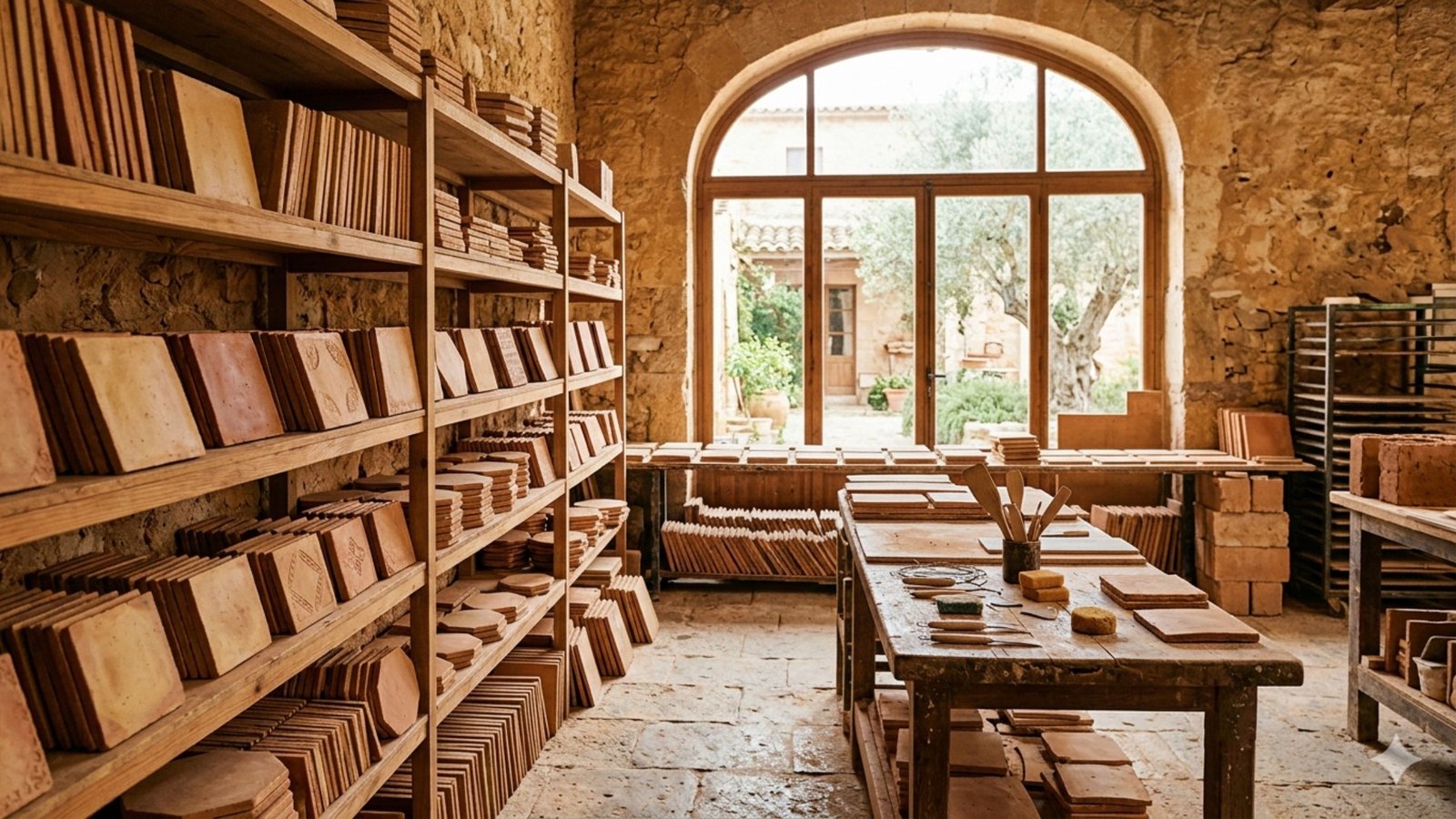

The price of terracotta tiles is one of the most frequently asked questions – and one of the least transparently answered. Many suppliers avoid the topic or hide behind “price on request.” The result is predictable: the interested buyer leaves the page, searches elsewhere, finds a number without context – and either concludes that terracotta is too expensive, or chooses a cheaper alternative without fully understanding what is being sacrificed.
This text takes a different approach. We provide realistic price ranges. More importantly, we explain what these figures actually represent – and why the price of a handmade traditional terracotta tile is not merely a cost factor, but an expression of everything that has gone into its creation.
Terracotta Tiles Price – what does handmade quality cost?
Prices for handmade traditional terracotta tiles from quality-oriented manufacturers typically start at around €70 per square metre, depending on format, thickness, and surface finish.
For comparison: a standard industrial tile is available from around €15–30 per m². High-quality porcelain stoneware typically ranges between €40–70 per m². A genuine handmade traditional terracotta tile – shaped by hand, naturally dried and fired in a wood-fired kiln – is intentionally and justifiably positioned above this level.
However, this figure alone says very little. The real question is: what exactly are you buying?
Two to three weeks before the tile leaves the workshop
To truly understand the price of terracotta tiles, one must understand what precedes the finished piece.
Everything begins with pure natural clay – without additives, without industrial processing aids. Only clay and water. Each tile is shaped by hand, one at a time. Pressure, consistency, thickness – all of this depends on the craftsperson’s experience and on a sensitivity that cannot be programmed or transferred to a machine.
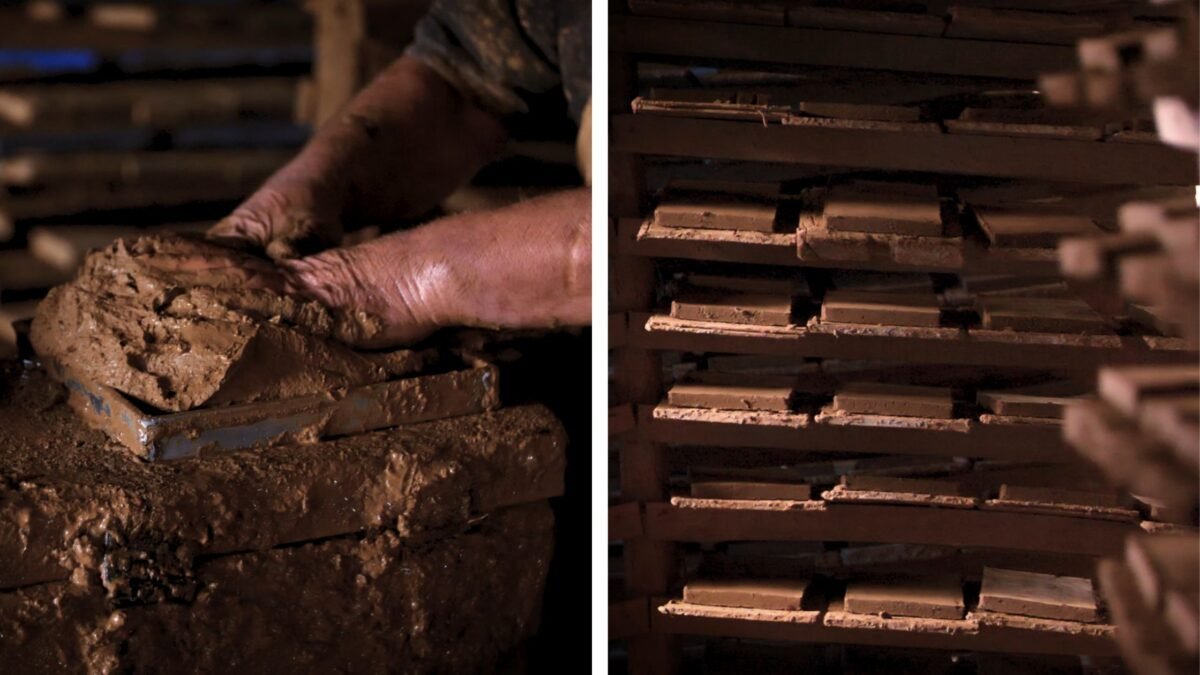
After shaping, the drying process begins. The tile cannot be rushed. Natural air drying takes days, sometimes weeks – depending on humidity, temperature, and air circulation in the workshop. If the process is too fast, the tile may warp or crack. If it is not sufficiently dry before entering the kiln, residual moisture can expand too quickly at high temperatures, causing the tile to break. Each phase requires attention and experience that cannot be replaced by speed.
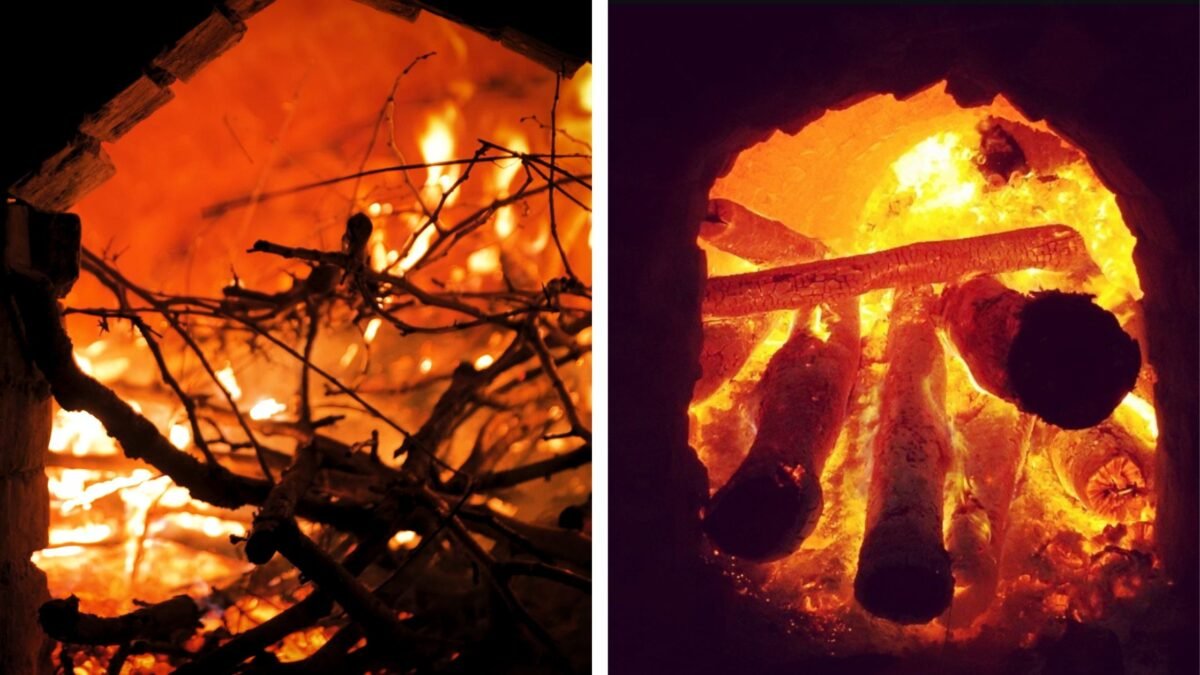
Once the tile is ready, it is placed in the wood-fired kiln. The kiln is heated gradually – a process that takes between 24 and 36 hours. Firing takes place at around 1,000 °C, without digital control systems, guided solely by the kiln master’s experience and trained eye. After firing, the kiln requires an additional two to three days to cool before the tiles can be removed. This is a considerably more demanding process than that used by manufacturers who may still follow traditional production methods but, often due to regulatory requirements, fire their tiles in electric or gas kilns. In those cases, the tiles are placed on metal racks, inserted into the kiln, and simply removed once the firing cycle is complete.
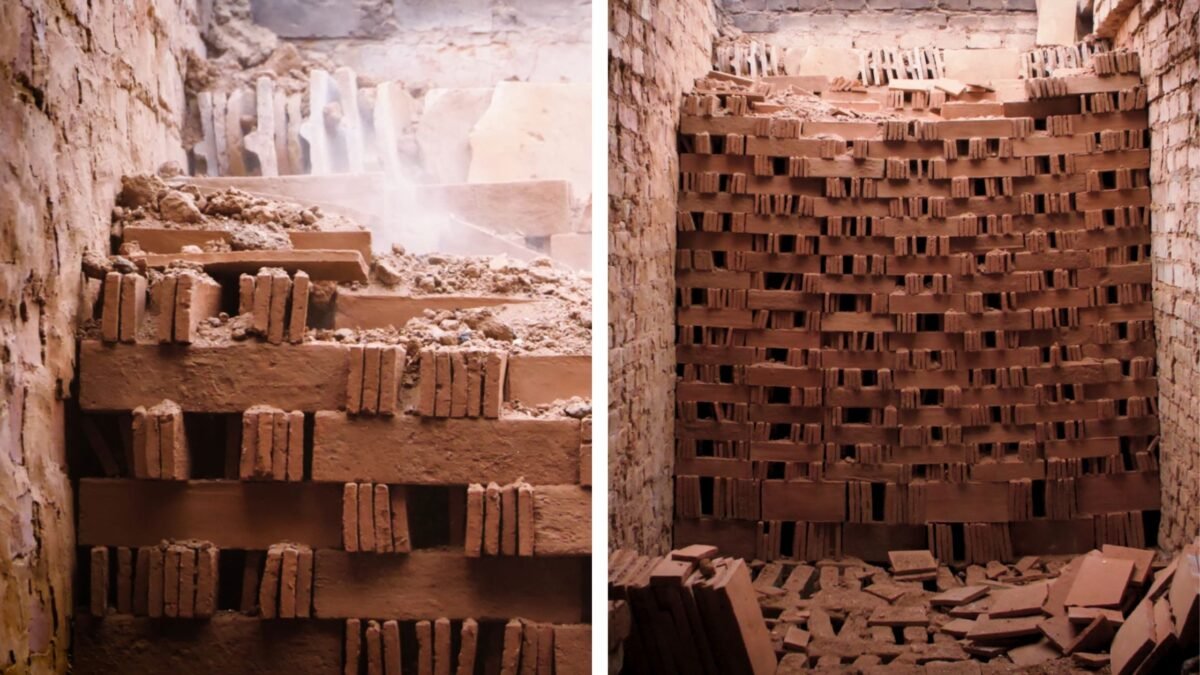
The entire production cycle – from shaping to removing the fired traditional terracotta tiles from the kiln – takes at least two to three weeks under optimal conditions.
A concrete example helps make this more tangible. A square tile in the 20×20 cm format results in 25 pieces per m². A project covering 50 m² therefore requires 1,250 tiles. Each individual piece is shaped by hand – both sides worked, turned, and checked. Every tile is then placed individually on shelves to dry, monitored throughout the entire drying process and repositioned if necessary. Once drying is complete, all tiles are carefully loaded into the wood-fired kiln by hand. After firing and the long cooling phase, each tile is removed individually, inspected for quality, and stacked on pallets by hand. The exact ordered quantity is never produced – more pieces are always made, because craftsmanship does not guarantee a perfectly predictable yield.
This is what the client is paying for – a craft that has endured for centuries, knowledge passed down through generations, experience built through years of daily work, and attention devoted to every single piece, every movement. In short – craftsmanship. And craftsmanship is not industry. No matter how much industry attempts to replicate it, it can never truly reproduce it.
More about the exact manufacturing process: The legacy of old masters – how our handmade traditional terracotta tiles are created
What is included in the terracotta tiles price
The work itself is the first and most significant factor. An industrial tile is pressed, printed and fired in a fully automated process. Thousands of identical pieces are produced every hour. A handmade traditional terracotta tile cannot be produced faster without compromising the result. Each tile carries subtle variations – in colour, surface and dimension – which are the direct evidence of human hands. This is not a romantic detail. It is the reason the tile creates the effect it does in a space: alive, warm and impossible to replicate.
The material is the second factor. Traditional terracotta is made from natural clay, without synthetic additives. The quality of the clay, its origin, and the way it is prepared directly influence durability, colour range and the behaviour of the finished tile over decades. High-quality raw material is not inexpensive. Proper firing is not inexpensive either.
Unavoidable losses are the third factor. In any craft-based process, not everything that begins production becomes a finished product. Tiles that warp are not sold. Tiles that crack are not sold. Tiles with surface irregularities beyond the acceptable range of variation are not sold. These pieces represent real time, real material and real cost – and they are reflected in the price of the tiles that ultimately leave the workshop.
Thickness is the fourth factor. Handmade traditional terracotta tiles are typically 1.8 to 2.5 cm thick – significantly more than most industrial tiles. This influences everything: the amount of clay required, firing time, transport weight and installation requirements. A thicker tile is also a more durable tile – one that can be refinished and restored decades later rather than replaced.
What goes beyond the terracotta tiles price: complete budget planning
The price per square metre of the tile is only one part of the renovation budget. Anyone planning seriously must consider the full picture.
Substrate preparation is not optional – it is essential. The screed must be level, stable and completely dry. Costs vary significantly depending on the condition of the existing floor and should be considered as a separate item in the budget before defining the tile budget.
The professional installation of handmade traditional terracotta tiles is not the same as installing industrial tiles. Each tile is slightly unique. Adjusting, cutting and achieving proper slopes in wet areas require a craftsperson who understands the material. As a general guideline, installation costs typically range between €25–45 per m², depending on complexity and pattern.
Impregnation is part of the system, not an afterthought. When applied correctly, it determines how the material performs and ages over many years. As a general guideline, material costs range between €5–15 per m², depending on the product and whether the application is carried out by a professional or the owner. Learn more: Protection for generations – how to properly impregnate terracotta tiles
Grout – especially in wet areas – is another critical component. Incorrect selection or poorly executed transitions are among the most common causes of problems that are often wrongly attributed to the tile itself. Tile and grout function as one system. Both must be carefully specified and properly executed. Further reading: Joints and transitions in handmade traditional terracotta tiles
Terracotta tiles price calculated over twenty years
This is where the calculation changes.
Handmade traditional terracotta tiles, when correctly installed and properly impregnated, do not lose their structural integrity over time. Instead, they develop a patina – a positive transformation of character rather than a form of deterioration. Periodic re-impregnation is the only regular maintenance required.
An industrial tile floor in a residential setting typically has a realistic lifespan of 15 to 25 years before it begins to appear worn, before the surface finish shows signs of use, and before the grout joints reveal the traces of everything they have endured. At that point, renovation becomes the next step – bringing with it additional effort, cost and material waste.
A handmade traditional terracotta floor, correctly installed and minimally maintained, does not share this limited horizon. A floor that lasts for generations is not a theory – it is an archaeological reality. The Roman city of Viminacium, in present-day Serbia, one of Europe’s most important archaeological sites, provides clear evidence: terracotta floors dating from the 1st to the 4th century AD are still preserved there today – nearly 2,000 years after their creation.
Floors in old Tuscan farmhouses, in the entrance halls of centuries-old buildings in Vienna, in the monastery corridors of Andalusia – this is handmade traditional terracotta. Still in use. Still functional. Still beautiful in a way that has nothing to do with fashion, because it was never fashionable. It was simply authentic.
When the cost is considered over such a lifespan, the initial investment appears in a different light. Not inexpensive – nothing in true craftsmanship is inexpensive, nor should it pretend to be. But honest.
Price is always relative. The real question is not what it costs – but how long it lasts.
How to plan the budget correctly
Planning a project with handmade traditional terracotta tiles is not complicated – but it does require slightly more attention than standard materials. When ordering, always include an additional 10–15% to cover cuts and potential breakage during installation. Tiles from different production batches may vary slightly in tone; keeping a reserve from the original batch is considered good practice.
When requesting a quotation, ask for a complete one – including tiles, substrate preparation, installation and impregnation. Only then will you gain a realistic understanding of the total cost. And order samples before making the final decision. Terracotta appears different in your own space, under your own light, than it does on a screen or in a showroom. Holding the actual tiles in your hand is the only reliable reference.
Conclusion: the terracotta tiles price as an architectural decision
The price of handmade traditional terracotta is not high because the material itself is a luxury. It is higher because it reflects a process that cannot be accelerated, standardised or automated without changing the result
Those who choose a handmade tile are not simply selecting a surface. They are choosing weeks of attention, experience and uncertainty, condensed into a single piece of fired clay. They are choosing a material that gives a space a character the industry attempts to imitate, but cannot truly reproduce.
The irregularities of a handmade tile – the subtle variations in colour, the slight differences in thickness, the texture that cannot be printed onto a porcelain surface – are not imperfections. They are evidence of the process. This is precisely why the floor appears different at midday than it does in the evening light, and why it gives a kitchen or entrance area a character that makes people pause, even if they cannot immediately explain why.
This character cannot be produced through mass manufacturing. And that is precisely why it costs what it costs.
Understanding this difference transforms the question “why so expensive?” into a conclusion that becomes self-evident.
Further reading: